01
Dynamic Lock Screen Widgets
Configuring dynamic updates via Apple WidgetKit and Android Glance modules from a shared background coordinator.

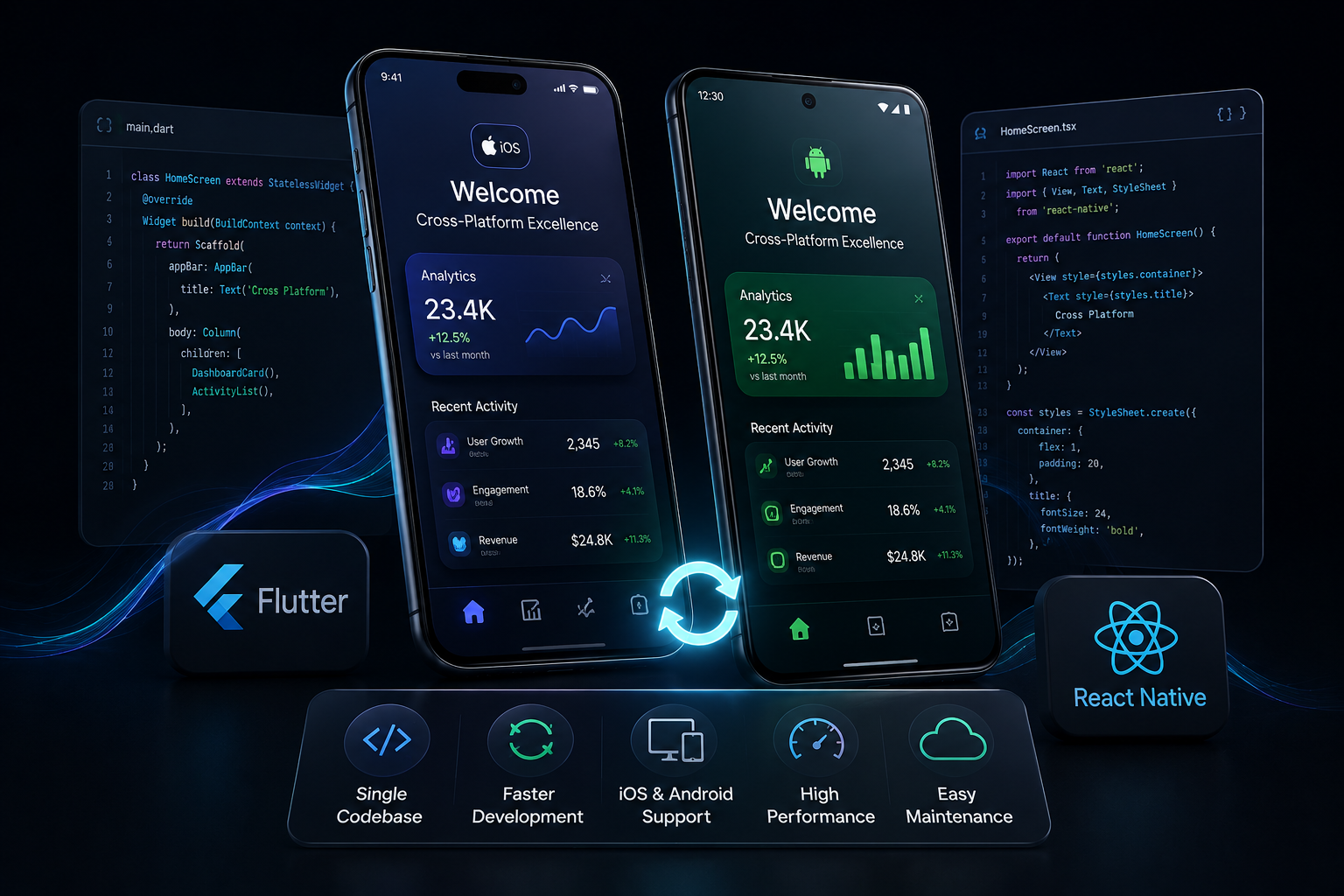
ORA builds scalable cross platform applications for iOS and Android using Flutter and React Native. We help businesses launch faster, maintain one streamlined codebase, and deliver consistent, high performance experiences across devices.
Framework
Flutter
Framework
React Native
Platforms
iOS & Android
Delivery
Faster Launch
150M+
App Downloads Generated
4.9 ★
Average Dual Store Rating
12+
Years of Mobile Specialization
95%+
Shared Code Reuse Rate
Cross platform development requires careful balancing of shared files. We design applications that respect native navigation paradigms, scale screens gracefully, and access native sensors without latency.
import React from 'react';
import Flutter from 'flutter';

// Build once, run anywhere
const App = () => (
  return (
    <Experience
      performance="high"
      design="adaptive"
      security="strong"
    />
  );
);Building high performance, fluid user experiences using TypeScript, React Native, Dart, and Flutter frameworks.
Sharing over 70% of business logic, database queries, and helper classes to cut development costs and update timelines in half.
Structuring UI components that map automatically to native widgets, respecting platform gestures and dynamic system styling.
Protecting sensitive user data using Keychain (iOS) and Keystore (Android) wrappers under single unified APIs.
Integrating TensorFlow Lite models and Google ML Kit packages for dynamic object recognition and translation on both OS builds.
Writing clean Swift, Objective-C, and Kotlin bridges to interact with specialized OS frameworks when native access is required.
Configuring SQLite, WatermelonDB, or Hive structures to caching server endpoints for offline first responsiveness.
Analyzing frame rate performance, wake locks, and rendering cycles using Xcode Instruments and Android Profilers.
Modern cross platform products extend beyond basic views. We construct widgets, responsive layouts, push sync engines, and accessory watch links under a shared codebase.
01
Configuring dynamic updates via Apple WidgetKit and Android Glance modules from a shared background coordinator.
02
Designing responsive layouts that scale cleanly across iPads, Android foldables, and different phone dimensions.
03
Wiring Firebase Cloud Messaging (FCM) and Apple Push notifications (APNs) under a single cloud dispatcher.
04
Linking wearable companion apps to your core cross platform database for synchronized data logging.
We leverage industry standard compilers and shared state managers to build cross platform code that behaves correctly across all targeted screen specifications.
TS-Based Hybrid Framework
Dart-Based Dynamic UI SDK
Compile-safe Platform Coding
Shared Local Persistence Engine
Robust State Managers
Custom Swift & Kotlin Adapters
Serverless Auth & Cloud Systems
Build Compilers & CI/CD Pipelines
Different products demand different architectural focuses. We customize our tech stack to suit your industry's standards for safety, speed, and hardware connectivity.
01
Bridging Apple HealthKit and Android Health Connect metrics under a single privacy-compliant interface design.
02
Integrating Apple Pay, Google Pay, and custom biometric prompts securely into a single checkout flow.
03
Pairing companion apps with smart rings and low energy BLE devices using unified background bluetooth streams.
04
Building responsive operations applications featuring offline mapping support, document scanning, and signature captures.
Our structured mobile delivery process keeps compliance, native integrations, and launch milestones on track from first workshop to live operations.
01
We map your workflows, choose React Native vs Flutter, and define offline strategy in a focused 5-day scoping sprint.
02
We design scalable architecture, shared components, and hybrid prototypes following iOS HIG and Material rules.
03
2-week sprints to build shared screens and native bridge components with weekly cross-platform builds.
04
Parallel test pipelines on iOS & Android, encryption validation, and preparing privacy & data safety documentation.
05
Deploy to TestFlight/Play Beta, manage dual store reviews, CI/CD pipelines, and 90-day post launch support.
To prevent review rejections, we run a pre submission deployment checklist. We make sure all privacy controls, testing tracks, and target SDK attributes comply with both Apple and Google rules.
01
Creating App Store Connect profiles and Google Play testing tracks concurrently for reviews.
01
Creating App Store Connect profiles and Google Play testing tracks concurrently for reviews.
02
Verifying iOS deployment targets and Google Play target SDK values are set to meet submission guidelines.
02
Verifying iOS deployment targets and Google Play target SDK values are set to meet submission guidelines.
03
Drafting disclosures for Apple's Nutrition Labels and Google Play's Data Safety declaration.
03
Drafting disclosures for Apple's Nutrition Labels and Google Play's Data Safety declaration.
04
Testing frame drops and memory profiles on a hardware device matrix (iOS & Android) before shipping.
04
Testing frame drops and memory profiles on a hardware device matrix (iOS & Android) before shipping.
Helpful answers about framework choice, code sharing statistics, native SDK access, and App Store submission routines.
5 questions answered
Modern frameworks like Flutter (which compiles to native ARM code) and React Native (which uses JS engines with native rendering threads) deliver near-native 60fps performance. Users cannot distinguish them from fully native apps for 95% of standard commercial use cases.
On average, our clients achieve between 85% to 95% code reuse. The remaining 5% to 15% consists of platform specific styles, assets, configuration scripts, and custom native bridges for accessing device level APIs.
We write custom native modules (bridges) in Swift (iOS) and Kotlin (Android) that communicate directly with the shared React Native or Flutter layer. This gives the app full access to native APIs while keeping the core logic unified.
It simplifies support significantly. Instead of maintaining two codebases (one in Swift, one in Kotlin), we manage a single codebase. Bug fixes, new features, and layout adjustments are made once and deployed to both stores simultaneously.
Yes, we manage dual submission end to end. We configure certificates, provision profiles, handle metadata in App Store Connect and Google Play Console, set up TestFlight/Play closed tracks, and support you through review phases.
Still stuck?
We reply within one business day.
From idea to deployment, we partner with you to build high-performance digital products that drive real-world impact and lasting user love.
Ship faster with iterative development and agile workflows.
Build with security, scalability and reliability at the core.
Custom solutions designed around your unique business goals.
We stay with you beyond launch with proactive maintenance and continuous support.
Rigorous testing and quality checks to ensure a bug-free experience.
Transparent communication and regular updates at every step.